
MAI-HOME
Published in Interreg Flanders–Netherlands; coordinated by Open Universiteit, 2023
An Interreg Flanders–Netherlands project (started September 2023) combating energy poverty and reducing CO₂ emissions from housing across Dutch and Belgian Limburg. Builds on the earlier GO-KIT pilot. Combines sensor-based monitoring of living behavior with occupancy and environmental forecasting models that generate personalized energy-saving guidance, delivered through gamification and social learning, on the premise that renovation alone doesn’t sustain energy savings once residents’ motivation fades. Also runs educational workshops and a MOOC for housing-corporation and municipal staff. Coordinated by Open Universiteit with five housing corporations, SMEs, and social/knowledge institutions. Total budget €4M over 3 years.
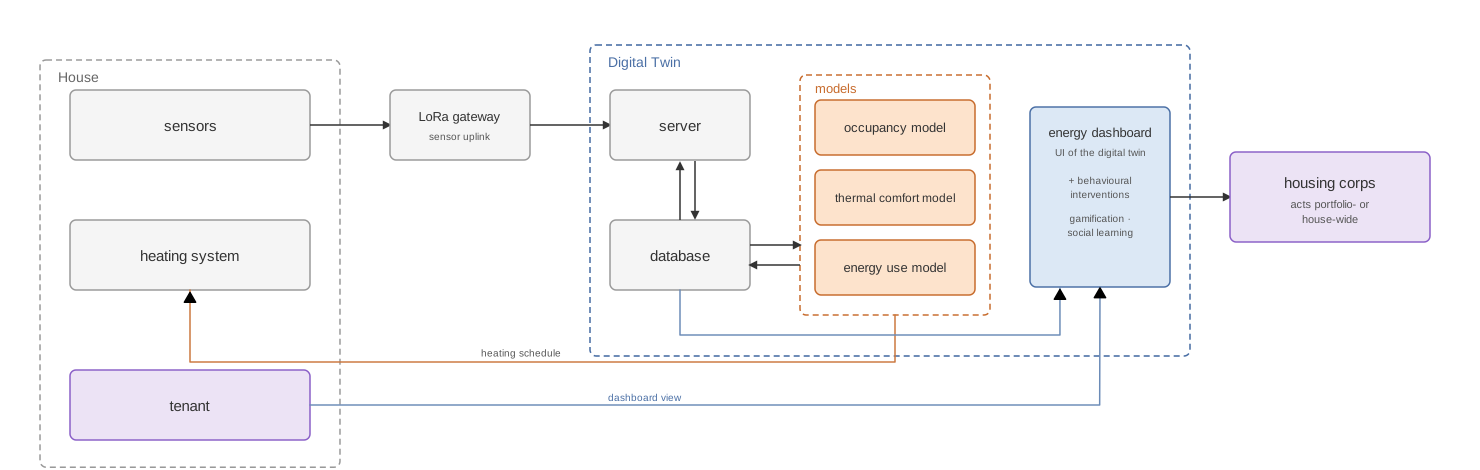
Has produced peer-reviewed papers in Energy and Buildings and at ACM SAC, and the HOMESENSE multisensor dataset (Scientific Data). See Publications.
Technology: Python ML pipeline with modular data-download, processing, training, and inference stages; LSTM and Transformer model architectures for occupancy and energy-use inference from sparse IoT sensor data.
My role: Joined in 2025 as work package lead, responsible for delivering the database, the models, and the energy dashboard. Also responsible for app design; implementation was carried out by a third party.